Bhutan, A Festival, and A Kira
- Nov 24, 2018
- 3 min read

BHUTAN, A FESTIVAL, AND A KIRA
A STORY ABOUT THE BLACK-NECKED CRANE FESTIVAL
CENTRAL BHUTAN
I’m trying to settle down sitting cross legged on the ground. I look around and it’s a sea of vibrant color around me.
Men are dressed in the usual gho, but remarkable would be the footwear of those running the show. They were wearing
knee-high boots with pointy toes, the tips of which elaborately embroidered. The women, on the other hand, were dressed
in shiny silk colorful boleros and traditional skirts, some of their best. Like them, I too am wrapped tightly in a woven skirt
but I don’t possess their grace nor their poise. I am bursting at the seams. Literally. The good thing is that I don’t need
to even try to hold my back straight in a seated position. The loaner “kira” I am wearing for this local festival at a
deep rural valley in Central Bhutan is doing that for me, and rather marvelously I might add. I try to suck in breaths
and minimize unnecessary movements so the whole thing, miraculously held only by a wide knit belt - sans buttons,
knots, or pins, only snugly tucked by muscle power alone and experience by Ama (mother) who was also my hostess
in their home the prior evening - doesn’t unravel in front of hundreds of Bhutanese people. It’s difficult when you’re
sitting cross legged, but I eventually became convinced that this kira (which is feeling more and more like a corset by
the second), isn’t going anywhere. I felt safe to shift to a kneeling position.
We are packed tightly shoulder-to-shoulder at the courtyard of the Buddhist temple in Gangtey (translates
to "hilltop" in Dzongkha) in the Phobjikha Valley of Central Bhutan, about 4 hours and a world away from its
capital, Thimphu. The festival was to celebrate the annual arrival of the threatened Black Necked Cranes that
come to warmer Phobjhika Valley from Tibet during the winter. The program hasn’t yet started and already I
start regretting wearing a layer of thin wool turtleneck inside my festival garb, the Bhutanese traditional
dress called a "kira". Luckily, the sun would sneak behind a cloud and the cool mountain air would
rescue me from having to figure out how to embarrassingly unpeel my kira layers in front of this
Bhutanese public who already has given me some amused and curious stares. The celebration soon
commenced and I keep checking the piece of printed programme they gave me at the door and
noticed that they immediately went out of order.
I stow the paper away.


The festivities itself consisted of mostly folk song and traditional dance performances with breaks of
local parlor games for children. You can tell that the town has seen various iterations of this same show many
times, but no one seemed to mind. It was a big social affair, perhaps rare, and everyone was having a ball.
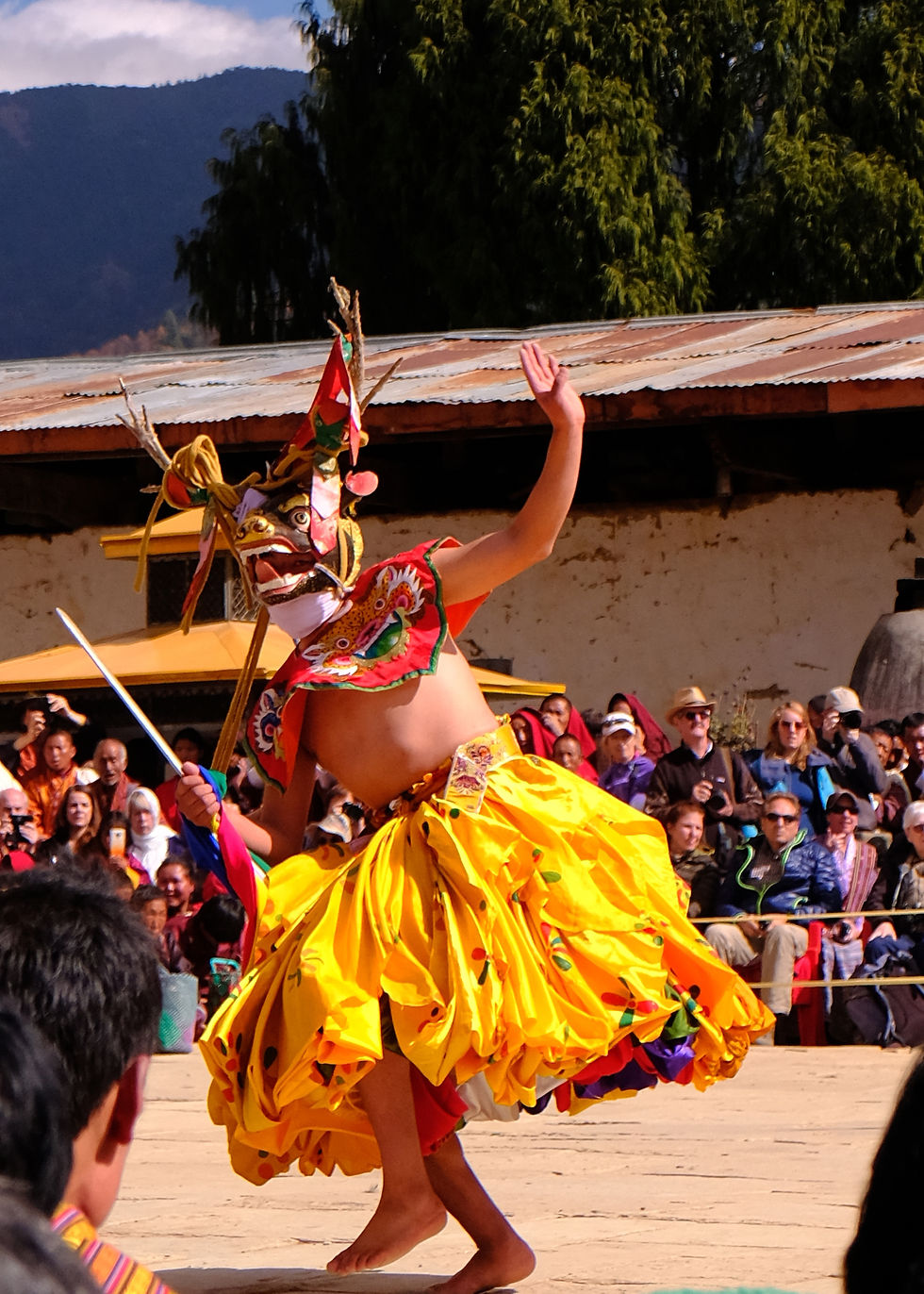
Among the performances, I found the mask dances called "cham" most intriguing. Performed by men dressed
in bright yellow poofy ball skirts that swish as they catapult their bodies in the air. This was done to the sound of
cymbals and their own small handheld percussion instrument. It was transfixing to watch their moving meditation,
so graceful and lithe. These dances are spiritual and religious in nature and often relay a story. In case of religious
festivals, it is believed that witnessing a mask dance is considered meritous that earns one bonus points.




In a couple of hours, it seemed like the local Bhutanese crowd multipled even more. Monks. Old ladies, mouths
red as they chew betel nut. Families with toddlers. A smattering of tourists. People showed up in groups, hauling
thermos flasks, mats, bags full of hot food, and babies and toddlers. They planted themselves wherever they
see a tiny sliver of unclaimed ground. I would soon realize their devious scheme. They came here with a mission.
This is an all-day affair for them and they are not relinquishing their precious real estate for a lunch break.
Lunch and tea for the family will be served right here. The pungent smell of the national dish "ema datshi"
(a stew of chilis cooked in cheese) and rice would give it away.


Lunch was also our cue to leave. I’m still bewildered that this wrap I have on did not
budge one bit. I shuffle about (to the squat toilet even - a proud accomplishment).
We have our own picnic waiting outside the temple grounds facing the mountains.
Bonus: Here's a little video I made about the Black Necked Crane Festival in Phobjikha Valley, Central Bhutan, November 2018


Comments