Bhutan: A Journey of a Lifetime
- Dec 3, 2018
- 6 min read

BHUTAN: A JOURNEY OF A LIFETIME
Ten years ago, I went on a solo journey across Asia, en route from the United States to the Motherland. I spent a few days freely navigating Hong Kong and Bangkok on my own, then heading off to an isolated island in the Andaman Sea in Southern Thailand, to sleep in a tent pitched on the beach, mere feet away from the water. I had a couple books with me, and “The Geography of Bliss” was one I reached for the most. Written by an NPR journalist, it tracks how happiness is defined and lived in everyday life all over the world.
It would be my first ever introduction to the small country of Bhutan, about the size of Switzerland, tucked away in the eastern Himalayas wedged in between Tibet, Nepal and India. The book described Bhutan’s government national policy of Gross National Happiness (GNH) and how every policy decision made on a national scale is vetted against the four pillars of GNH: good governance, sustainable socio-economic development, cultural preservation, and environmental conservation. While the rest of the world scrambles to increase their Gross Domestic Product, Bhutan is going on the less traveled path towards happiness instead. I was in rapture. I need to go Bhutan.

As it turns out, Bhutan is an expensive place to travel and as such, has become a somewhat exclusive destination. The government imposes a hefty daily tax on tourists (with a very few exceptions) that they justify as "high value, low impact". What this does is it weeds out travelers of the unsavory sort and what passes through the sieve are those genuinely seeking for a cultural (if a little spiritual) travel experience, and who would pay top dollar for it. Because of the price tag, it took a while for me to arrive, but ten years after I had read about it and all the while pining for it since, I finally set foot in the Kingdom of Bhutan.
Just like ten years ago, I would again find myself traveling solo, and I will not deny that while that makes part of me very anxious, a greater part of me is thrilled. My independent streak means I don't do well in big groups with strangers, and the upside to traveling solo on a big trip like this is that I get to feel and absorb everything purely on my own, by myself. I will admit that there were times when it got lonely, but there were always other travelers to strike conversations and build spontaneous connections with, before I retreated to my own reflections and thoughts at the end of each day. Besides, Bhutan travel rules dictate that I am constantly with a guide and a driver, so in Bhutan, I was never really alone.


Bhutan has been sequestered from the Western world for a very long time, and rather intentionally. It was the last country in the world to introduce television and internet, only in 1999. It was a ruled by a monarch for all its history, until the King voluntarily abdicated and Bhutan's first democratic elections were held in 2008, making it the youngest Democracy to-date (they still have a monarchy, but it's a Constitutional one, much like England). Although technology and change have undeniably brought modernity to Bhutan, there are parts of it that still pulsates with a certain naïveté and innocence. And I find all of that disarming in the beginning, but also became the reason why I can’t seem to shake it off. Bhutan is like no other place I have ever been.
Although most individuals carry a cellphone with good service and pretty reliable WiFi connection in the most unexpected and remote places, the fact is that there are parts of eastern Bhutan that were connected to an electric grid just two months ago and by a road system two years ago. Also, despite the seeming social ascendancy in major cities like Thimphu and Paro, children - tiny ones as young as 5 or 6 years old - walk by themselves to and from school everyday. Depending on where they live, they can walk up to one to two hours each way just to go to school. Now let that sink in and allow it to provide perspective.


I was in Central Bhutan for two days and had the privilege of staying with a local Bhutanese family. This is one of my favorite parts of the trip, because a big group of us huddled around a wood-burning stove that made the room hot, while sharing a meal, stories, and laughter. It is a rare occasion for guests and guides to be eating together in the same room, partaking of the same meal, so it was extraordinary (and just more fun and convivial, to be honest). As the meal was being prepared by our hosts, the TV was on but nobody seemed to pay any mind. There was an archery match in the afternoon and that evening, a rather dull singing contest was on. It was neither riveting nor "un-Bhutanese", and for this, I’m a little bit reassured that the corruption of rural Bhutan by way of media may eventually happen, but it probably won't happen in light speed.


I came to Bhutan intrigued by Gross National Happiness (GNH), seeking what that means and how it manifests in the people. I wanted to find out for myself how this tiny kingdom in the Himalayas of less than a million people has come to prioritize happiness over capitalism and consumerism. On Day Two, I had to abandon this quest. I realized it was futile to seek answers when I am looking at everything with a Western filter. I was applying my own narrow biases of what "happiness" means. I was searching for indicators of wealth, success, and prosperity - for tangible measures, physical manifestations of things that money can acquire. What I realized as the days went on is that Buddhism permeates the Bhutanese life in profound ways. In an orthodox Buddhist society, happiness is never measured in things that are impermanent and that pass. The answers I was looking for will forever elude me if I keep looking for signs of it where it doesn't exist. My version of happiness is an illusion. Happiness dwells in the conviction that suffering pervades all life and to overcome suffering, one must eliminate the cause of suffering, which is the clinging on and reliance on things that are intrinsically impermanent. It doesn't mean overachieving, and amassing property and cars and physical crap because none of that makes you truly and deeply happy. In these parts, happiness is contentment. And contentment is surveying your life and saying to yourself, “What I have is enough”.


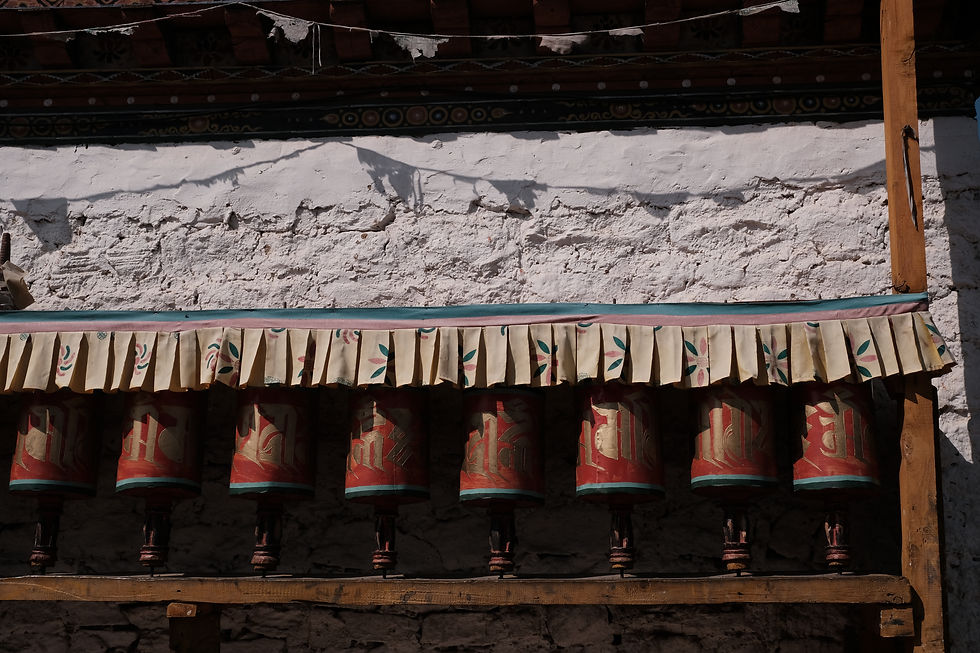
And so instead of overthinking everything, I finally surrendered to the experience and just opened myself to having the answers find me. With each day, with each mountain, with each monastery and prayer wheel, it got easier to shed expectations of what this trip needed to be and I just allowed the experience to swallow and consume me. And it did.
Is Bhutan the happiest place on earth? I don’t know. And after spending time here, I think this debate is immaterial. What I know with guaranteed certainty is that a chamber of my heart feels hollowed out, carved with mountains and babies with round sunburnt cheeks, with trails leading to remote places of prayer carved on mountaintops and cliffs, of prayer wheels and prayer flags, flapping in the high passes, of dirt roads and hairpin turns and rice fields and men in robes and cows and yak blocking the road and really deep but high valleys next to rivers and snow and glacier-covered Himalayan mountain peaks.


I would catch myself in the mirror here and I pause. Disencumbered from the trappings of real life, (whatever "real" means), untethered to a watch, a calendar - to time essentially, to decisions, to people’s expectations, to control or any pretense of it, I realize I am happy here. It has been a profoundly and wildly provocative and expansive experience.
They say travel changes us, but here in Bhutan, I don't feel changed. In fact, I've felt more myself here than I can remember. I feel connected to something I have forgotten or misplaced or shoved aside or lost. Regardless, I feel so grounded, like my heart has just been cut open.


Comments